Do you ask for 'locke empiricism essay'? You will find all the information on this section.
Locke’s monumental An Essay Concerning Human Perceptive (1689) is ane of the 1st great defenses of modern empiricism and concerns itself with determining the limits of human perceptive in respect to a wide spectrum of topics. Information technology thus tells us in some contingent what one hind end legitimately claim to know and what one cannot.
Table of contents
- Locke empiricism essay in 2021
- John locke an essay concerning human understanding full text
- John locke tabula rasa
- John locke empiricism
- Locke's approach to knowledge
- An essay concerning human understanding citation
- An essay concerning human understanding summary
- Empiricism rené descartes
Locke empiricism essay in 2021
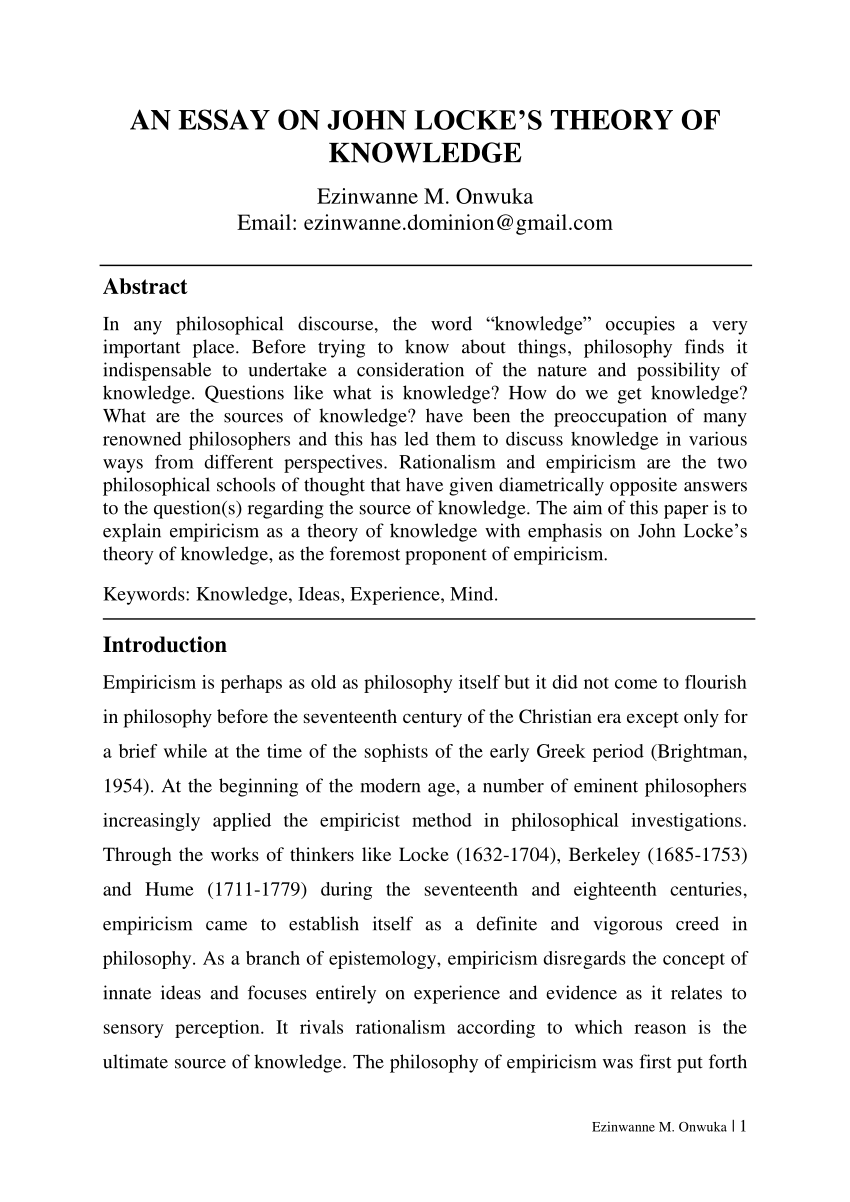 This picture representes locke empiricism essay.
John locke an essay concerning human understanding full text
 This picture demonstrates John locke an essay concerning human understanding full text.
John locke tabula rasa
 This image representes John locke tabula rasa.
John locke empiricism
 This picture demonstrates John locke empiricism.
Locke's approach to knowledge
 This image demonstrates Locke's approach to knowledge.
An essay concerning human understanding citation
 This image illustrates An essay concerning human understanding citation.
An essay concerning human understanding summary
 This picture illustrates An essay concerning human understanding summary.
Empiricism rené descartes
 This picture shows Empiricism rené descartes.
What did John Locke believe about the origin of knowledge?
Show More John Locke (1632-1704) was an English Empiricist. Empiricists’ belief was that origin of knowledge is experience. Empiricism is defined as a theory that suggests that sense experience is the origin of consciousness.
What did John Locke say about sensory experience?
A philosopher who had particularly influential things to say about these questions is the 17th-century English philosopher, John Locke, who argued that knowledge is demonstrably acquired only through sensory experience, but that our sensory experience is not infallible. John Locke, as perceived by your senses.
How did Hume and Locke come up with the philosophy of experience?
The knowledge of anything is not embedded into our minds from birth; it must be obtained. In order to gain this knowledge, both Hume and Locke concur that one must experience life. By doing this, we allow ourselves to perceive the world around us, thus providing us with opportunities to build upon our present sense of reasoning.
What did John Locke mean by empiricism?
Locke's empiricism emphasizes the importance of the experience of the senses in pursuit of knowledge rather that intuitive speculation of deduction.
Last Update: Oct 2021